
Blog
The Complete Guide to GLP-1 for Hormonal Weight Gain: PCOS, Perimenopause, Postpartum, and Thyroid Changes

What Causes Hormonal Weight Gain?
Hormonal weight gain happens when a hormone shift, not a change in diet or activity, makes the body store more fat and burn less energy. PCOS, perimenopause, postpartum recovery, and thyroid conditions all trigger it through one of two overlapping mechanisms: rising insulin resistance or falling estrogen. The trigger is different for each. The trap it creates is largely the same.
Key takeaways
- PCOS, perimenopause, postpartum weight retention, and thyroid conditions are four different starting points that tend to converge on the same two mechanisms: insulin resistance and estrogen decline.
- This is why “eat less, move more” advice quietly stops working for a lot of women in their 30s and 40s. It is not a discipline problem.
- Timing and safety data are the biggest open questions for postpartum GLP-1 use, especially while breastfeeding, and the answer differs between semaglutide and tirzepatide.
- Hypothyroidism itself is not a reason to avoid GLP-1 treatment. A personal or family history of medullary thyroid cancer or MEN2 is the actual contraindication, and the two get confused often.
- If PCOS specifically is your situation, this guide links out to a full, dedicated breakdown rather than repeating it here.
At a glance
| 1-1.5 lbs/yr average weight gain per year through midlife, regardless of cause | 6-13% women of reproductive age affected by PCOS | 40-60% women who gain more than the recommended amount during pregnancy | 21,538 patients in the largest study linking GLP-1 treatment to thyroid hormone changes |
What’s in this guide
- Part 1: The shared mechanism behind hormonal weight gain, and a lookup table to find your specific driver
- Part 2: PCOS in brief, and perimenopause weight gain on its own, without a PCOS history
- Part 3: Postpartum timing and breastfeeding safety, and hypothyroidism and weight
- Part 4: A screening checklist, red flags, and 12 frequently asked questions
Part 1: The Shared Mechanism
The Shared Mechanism Behind PCOS, Perimenopause, Postpartum, and Thyroid Weight Gain
Hormonal weight gain has four very different life events behind it, and they tend to funnel into the same two biological changes.
The first is insulin resistance: cells respond less efficiently to insulin, blood sugar runs higher, and the body compensates by producing more insulin, which promotes fat storage. This is the defining feature of PCOS, but it also shows up with an underactive thyroid, and it worsens with the estrogen decline of perimenopause.
The second is estrogen decline. Estrogen influences where fat gets stored and how strong your appetite signals are. As it drops during perimenopause, and sharply right after childbirth, fat shifts toward the midsection and hunger cues get harder to override with willpower alone.
| Weight gain in your 30s and 40s is rarely a habits problem showing up for the first time. More often, it is the same habits meeting a body that now runs on different hormonal rules. |
Women gain an average of 1 to 1.5 pounds a year through midlife, independent of whether the specific trigger is PCOS, the menopause transition, a pregnancy, or a thyroid condition. That is the backdrop this guide works against. What differs by driver is not whether weight gain happens, but what actually helps, and what to check with a provider before starting treatment.
Which Hormonal Driver Applies to You?
Hormonal weight gain is not one condition. Use this table as a starting point, not a diagnosis, since several drivers can overlap.
| Driver | A sign it might be this | Where to go deeper |
| PCOS | Irregular cycles and weight resistance since your teens or 20s | Full PCOS and Menopause guide |
| Perimenopause, no PCOS | New weight gain in your 40s, especially midsection, with cycle changes or hot flashes | This guide, Part 2 |
| Postpartum | Weight gain or retention after pregnancy, possibly while breastfeeding | This guide, Part 3 |
| Thyroid | Fatigue, cold intolerance, weight gain despite thyroid medication | This guide, Part 3 |
If PCOS is your situation, especially alongside perimenopause or menopause, our Complete Guide to PCOS and Menopause covers the 2026 PMOS name change, the four life stages, symptom overlap, long-term risk, and the specific research on GLP-1 treatment in PCOS in full depth. This guide does not repeat that material. It picks up everywhere else.
Part 2: PCOS in Brief, and Perimenopause on Its Own
PCOS and Weight Gain, in Brief
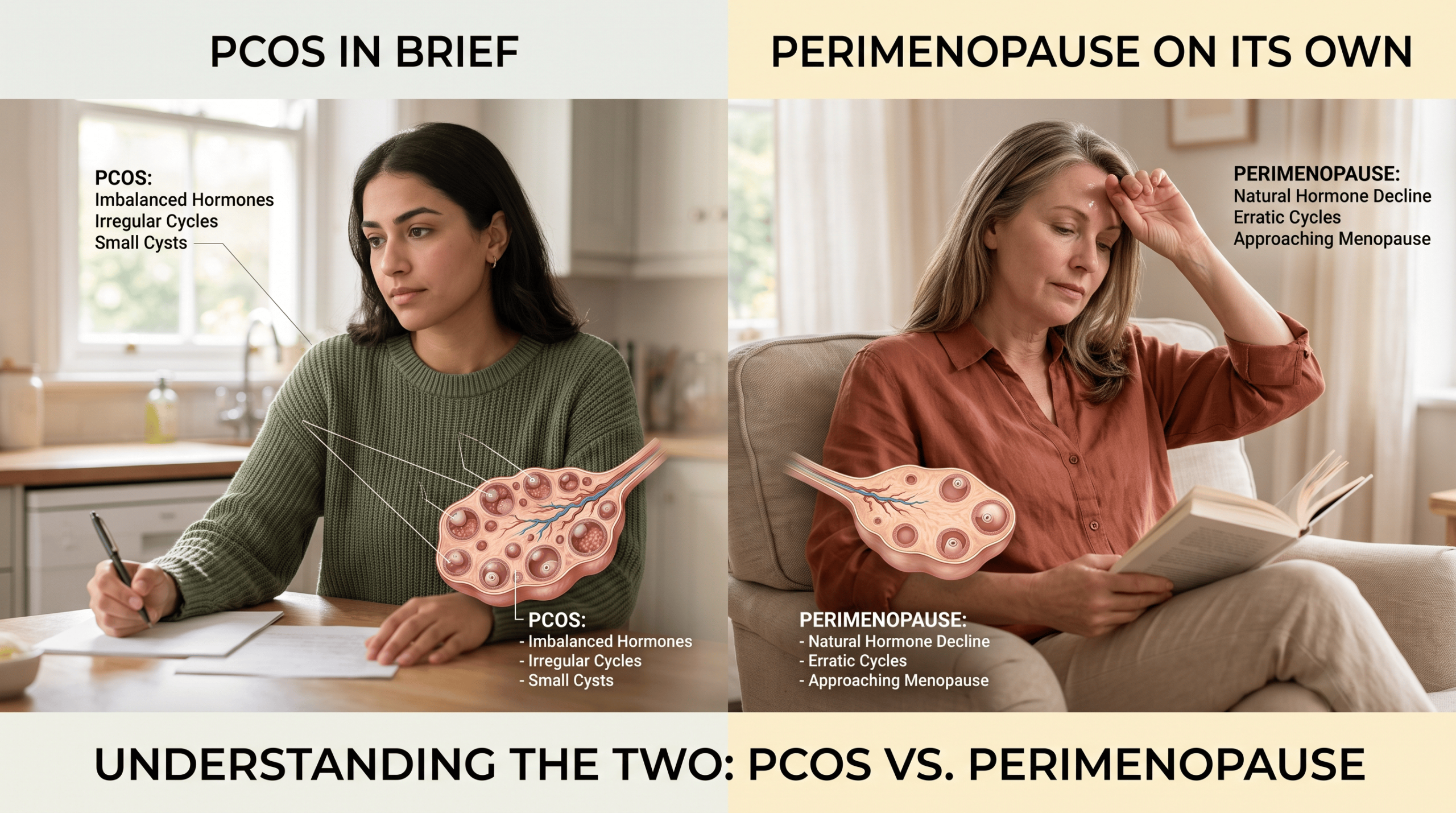
PCOS drives weight gain mainly through insulin resistance, which increases both blood sugar and androgen production. It affects roughly 6 to 13% of women of reproductive age and does not resolve at menopause. Semaglutide and tirzepatide are not approved to treat PCOS itself, but a peer-reviewed meta-analysis of randomized trials found meaningful weight loss with both, strongest in women who also have obesity.
For the full picture, including the 2026 PCOS-to-PMOS rename, the four life stages, a symptom comparison table, current cognitive-health research, and the specific weight-loss data by medication, see the Complete Guide to PCOS and Menopause.
Perimenopause Weight Gain Without a PCOS History
Perimenopause causes weight gain on its own, independent of any PCOS history, and it is the more common version most women in their 40s actually experience. The mechanism is estrogen decline rather than insulin resistance from the start, though insulin resistance typically develops alongside it.
Estrogen helps regulate where the body stores fat. As levels fluctuate and then drop through perimenopause, fat storage shifts from the hips and thighs toward the abdomen, a change that happens even in women who do not gain any weight on the scale. At the same time, resting metabolic rate declines as lean muscle mass naturally decreases with age, and sleep disruption from hot flashes and night sweats compounds both problems by driving cravings and fatigue the next day.
This is why clinicians increasingly describe perimenopause, starting as early as the mid-30s for some women, as a window of metabolic opportunity rather than something to address only once symptoms are already disruptive. The body remains responsive to strength training, protein intake, and sleep regulation during this window in a way that becomes harder to reverse once fat redistribution plateaus after menopause.
A review of GLP-1 receptor agonists specifically in perimenopausal and postmenopausal women found benefits across weight, central adiposity, and cardiometabolic markers, largely independent of whether a woman is also using hormone therapy. That makes GLP-1 treatment and menopausal hormone therapy reasonable to discuss as separate, potentially complementary questions with a provider, rather than an either-or choice.
AHC offers compounded semaglutide and compounded tirzepatide after an individual evaluation, whether or not a PCOS diagnosis is part of your history.
Part 3: Postpartum and Thyroid
Postpartum Weight Retention: When Is It Safe to Start GLP-1 Treatment?
GLP-1 for hormonal weight gain after childbirth raises a timing question more than an eligibility one. Between 40 and 60% of women gain more than the recommended amount of weight during pregnancy, and postpartum weight retention is common regardless of how much was gained.
| Pregnancy: Semaglutide and tirzepatide are not used during pregnancy. Prescribing information advises stopping semaglutide at least two months before trying to conceive, and stopping either medication immediately if pregnancy occurs, due to potential fetal harm. |
Breastfeeding is where the more current, more encouraging research sits, though clinical guidance has not fully caught up to it yet. A 2024 study published in Nutrients tested breast milk from eight nursing mothers using semaglutide and found the drug undetectable in every sample, with a worst-case estimated infant dose of 1.26%, well under the 10% threshold generally used to judge medication safety during lactation.
Despite that reassuring finding, current clinical guidance still generally recommends waiting until breastfeeding ends before starting or restarting semaglutide, since long-term outcome data in breastfed infants remains insufficient, not because the preliminary data is concerning. Tirzepatide is further behind. The FDA has not evaluated its use during breastfeeding, and no comparable safety study exists yet, so caution there is more clear-cut.
For mothers who are not breastfeeding, most providers recommend waiting roughly 6 to 12 weeks postpartum before starting or restarting GLP-1 treatment, to allow initial recovery, though the right timing depends on individual healing and health history.
A free evaluation with an AHC provider is the right place to work through timing individually, especially if breastfeeding status or recovery is still changing.

Hypothyroidism and Weight: Where GLP-1 Treatment Fits, and Where It Doesn’t
Hypothyroidism slows metabolism and commonly causes weight gain that thyroid hormone replacement alone often only partly resolves, since much of the early loss on levothyroxine is water weight rather than fat. This has led many patients with a thyroid condition to ask whether GLP-1 treatment is an option, and the honest answer requires separating two things that get confused constantly.
| Hypothyroidism is common and is not, on its own, a reason to avoid semaglutide or tirzepatide. Current evidence supports GLP-1 treatment in patients with well-controlled hypothyroidism. A personal or family history of medullary thyroid carcinoma or Multiple Endocrine Neoplasia syndrome type 2 is the actual FDA-labeled contraindication for semaglutide and tirzepatide. This is a different, much rarer thing than routine hypothyroidism, and the two should never be treated as interchangeable. |
A recent analysis of 21,538 patients with hypothyroidism prescribed a GLP-1 medication found that meaningful weight loss was associated with measurable decreases in TSH levels, with semaglutide showing the largest effect among the medications studied. The practical implication is not that GLP-1 treatment fixes thyroid function. It is that significant weight loss can shift how much thyroid hormone replacement someone needs, which is a reason for closer monitoring, not a reason to avoid treatment.
One more practical detail worth knowing: GLP-1 medications slow gastric emptying, which could theoretically affect how well levothyroxine absorbs if the two are taken too close together. Keeping thyroid medication on its usual consistent schedule, and mentioning it during any GLP-1 evaluation, avoids the issue rather than needing to solve it after the fact.
Part 4: Getting Started
A Screening Checklist Before Starting
Bring this checklist to your evaluation, whichever driver applies to you.
1. A1C or fasting glucose, to assess insulin resistance.
2. A lipid panel, for cholesterol and triglycerides.
3. Thyroid function testing (TSH, and a full panel if you have a known thyroid condition).
4. Blood pressure check.
5. Confirmation of pregnancy status, and breastfeeding status if applicable.
6. If you have a PCOS history, the additional screening in the PCOS and Menopause guide.
When to See a Doctor Right Away
A short list of situations specific to this guide’s territory that deserve prompt medical attention rather than waiting:
- Any sign of an allergic reaction, such as swelling or difficulty breathing.
- Severe, persistent abdominal pain.
- Signs of a thyroid emergency, such as a rapid heartbeat, high fever, or severe agitation, if you have a thyroid condition.
- A noticeable drop in milk supply or signs of dehydration in your baby, if you are breastfeeding.
Frequently Asked Questions
What is hormonal weight gain?
Weight gain driven by a hormone shift rather than a change in diet or activity. PCOS, perimenopause, postpartum recovery, and thyroid conditions are the four most common drivers, and they tend to work through insulin resistance, estrogen decline, or both.
Is hormonal weight gain the same thing as PCOS?
No. PCOS is one specific driver of hormonal weight gain. Perimenopause, postpartum weight retention, and thyroid conditions are separate drivers that can happen with or without a PCOS history. See our Complete Guide to PCOS and Menopause for the PCOS-specific breakdown.
How is perimenopause weight gain different from regular weight gain?
It is driven by declining estrogen shifting fat toward the midsection and lowering resting metabolic rate, independent of any change in diet or exercise. This is why the same habits that worked in your 20s and 30s often stop working in your 40s.
How soon after giving birth can you start GLP-1 treatment?
Most providers recommend waiting roughly 6 to 12 weeks if you are not breastfeeding, to allow for recovery. If you are breastfeeding, current guidance generally recommends waiting until you have finished, despite reassuring preliminary safety data on semaglutide specifically.
Is semaglutide safe while breastfeeding?
A 2024 study found semaglutide undetectable in breast milk from nursing mothers, with a worst-case estimated infant dose well below standard safety thresholds. Despite that, current clinical guidance still generally recommends waiting until breastfeeding ends, since long-term infant outcome data is not yet available.
Can you take tirzepatide while breastfeeding?
This is less settled than semaglutide. The FDA has not evaluated tirzepatide use during breastfeeding, and no comparable safety study exists yet, so most guidance recommends waiting until breastfeeding ends.
Can you take semaglutide or tirzepatide if you have hypothyroidism?
Yes, in most cases. Well-controlled hypothyroidism is not, on its own, a reason to avoid GLP-1 treatment. The real contraindication is a personal or family history of medullary thyroid carcinoma or MEN2, which is a separate and much rarer thing.
Who should not take GLP-1 medications because of thyroid history?
Anyone with a personal or family history of medullary thyroid carcinoma or Multiple Endocrine Neoplasia syndrome type 2. This is the specific FDA-labeled contraindication, distinct from routine hypothyroidism.
Does losing weight on a GLP-1 change how much thyroid medication you need?
It can. Research following over 21,000 patients with hypothyroidism found meaningful weight loss on GLP-1 treatment was associated with measurable decreases in TSH levels, which is a reason for closer monitoring rather than a reason to avoid treatment.
Do GLP-1 medications treat the hormonal imbalance itself, or just the weight?
Just the weight, and any related metabolic markers. Semaglutide and tirzepatide are approved for chronic weight management or type 2 diabetes, not as a treatment for PCOS, perimenopause, postpartum hormone shifts, or thyroid conditions themselves.
How do you know which hormonal driver is behind your weight gain?
Timing and other symptoms are the best starting clues: lifelong cycle irregularity points toward PCOS, new midlife changes with hot flashes point toward perimenopause, timing after childbirth points toward postpartum, and fatigue or cold intolerance points toward thyroid. An individual evaluation is what actually confirms it.
Does AHC’s compounded semaglutide or tirzepatide require a specific diagnosis?
No. Eligibility is based on an individual evaluation with a licensed provider, not a specific hormonal diagnosis. Whatever is driving your weight gain, that evaluation is the starting point.
Find Out Which Driver Applies to You
Hormonal weight gain from PCOS, perimenopause, postpartum recovery, or a thyroid condition all work through overlapping but distinct paths. A free evaluation with a licensed AHC provider looks at your individual history rather than a generic checklist, to find out whether compounded semaglutide or compounded tirzepatide fits your specific hormonal weight gain picture.
| Start your free evaluation |
alternatehealthclub.com/affordable-medical-weight-loss
Free AHC calculators and tools
GLP-1 weight loss projection calculator
See all AHC weight loss calculators
Related reading
The Complete Guide to PCOS and Menopause
Semaglutide during perimenopause
Medical disclaimer
This article is for informational purposes only and is not a substitute for professional medical advice, diagnosis, or treatment. Always seek the advice of your physician or other qualified health provider with questions about a medical condition, especially regarding pregnancy, breastfeeding, or thyroid disease. Semaglutide and tirzepatide are prescription medications available only after an individual evaluation by a licensed provider. Results vary by individual, and AHC makes no guarantee of specific weight loss outcomes. Provider and compliance review is required before this article is published, given the eligibility, breastfeeding-timing, and thyroid-contraindication content it contains.