
Blog
The Complete Guide to Calorie Deficit Calculators for GLP-1 Weight Loss


How Do You Calculate a Calorie Deficit on a GLP-1 Medication?
A calorie deficit calculator for GLP-1 weight loss starts the same way any deficit calculation does, finding your maintenance calories and subtracting an amount, typically around 500 calories a day, the deficit size actually used in the pivotal semaglutide and tirzepatide trials. What changes on a GLP-1 is not the formula. It is the risk that appetite suppression pushes you well past that target without you trying to.
Key takeaways
- A roughly 500 calorie daily deficit is the size actually used in the STEP 1 and SURMOUNT-1 trials, a real, sourced reference point most calculators do not explain.
- Appetite suppression on a GLP-1 can reduce intake by 16 to 39% without any conscious effort, which means the real risk is usually eating too little, not too much.
- Simple deficit math assumes a fixed number keeps producing a fixed rate of loss. It does not, since your metabolism adjusts as you lose weight.
- Protein intake is what separates a deficit that preserves muscle from one that does not, especially once total food volume drops.
At a glance
| ~500 cal the daily deficit used in the STEP 1 and SURMOUNT-1 trial protocols | 16-39% typical reduction in food intake on a GLP-1, without conscious restriction | 1.2-1.6g protein per kilogram of body weight recommended to protect muscle during the deficit | 4-6 wks how often to recalculate as your weight changes |
What’s in this guide
- Part 1: Why the math works differently, and what the trials actually used
- Part 2: The model that beats simple math, and the real risk to watch for
- Part 3: Using the number day to day
Part 1: The Math, and What the Trials Used
Why the Math Works Differently When Appetite Is Suppressed
A calorie deficit is simple in concept: eat less than you burn, and the gap gets made up from stored body fat. On a GLP-1 medication, the deficit still works exactly that way. What is different is how you get there. Instead of consciously restricting food in response to a hunger signal that remains fully active, semaglutide and tirzepatide directly turn down that signal. Most people on a GLP-1 reduce their intake by roughly 16 to 39% without deliberately trying to eat less.
That is genuinely useful for sustaining a deficit. It also means the usual warning signs of undereating, constant hunger, obvious white-knuckling, do not show up the same way, which is exactly why a calorie deficit calculator matters more here, not less. Without appetite as a natural brake, it is easy to end up in a much larger deficit than intended.
The Deficit Clinical Trials Actually Used
This is what any real calorie deficit calculator should be built on, and most skip it. The pivotal trials behind semaglutide (STEP 1) and tirzepatide (SURMOUNT-1) used a dietary protocol built around a roughly 500 calorie daily deficit, alongside increased physical activity. That is the evidence-backed reference point behind the results those trials produced, not an arbitrary starting number.
A deficit that large is not automatically the right target for every individual. Starting weight, activity level, and how your body responds all matter. It is a sourced, trial-tested starting point to bring to your provider, not a number to self-prescribe and never revisit.
Part 2: The Model That Beats Simple Math
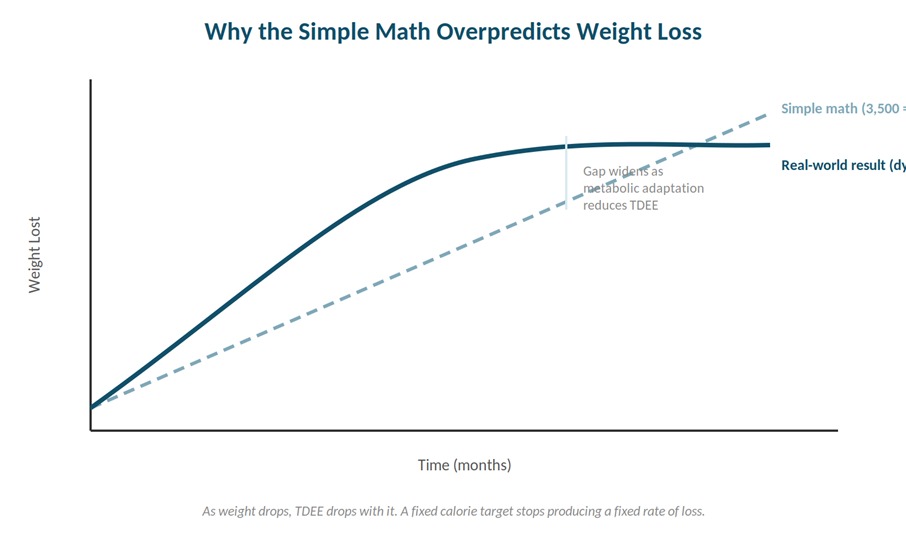
Simple Math vs. the Model That Accounts for Metabolic Adaptation
The old rule of thumb, 3,500 calories equals a pound, treats a calorie deficit as a fixed conversion: cut 500 calories a day, lose a pound a week, indefinitely. That rule is a reasonable starting estimate, but it is not how bodies actually respond over time, and it is a rule almost every GLP-1-specific calculator online still uses without qualification.
A more accurate model, developed at the National Institutes of Health, treats energy balance as dynamic rather than fixed. As you lose weight, your total daily energy expenditure drops, since a smaller body burns fewer calories at rest and during activity. The same 500 calorie deficit that produced steady loss at your starting weight produces less over time, not because anything went wrong, but because the target itself needs to move with your body.
| The simple math and the dynamic model agree early on. The gap between them widens the longer you stay in a deficit, which is exactly why recalculating matters more the further into treatment you are, not less. |
The full formula for calculating your maintenance calories, the number a deficit gets subtracted from, is covered in the TDEE Calculator guide, including a worked example and how often to redo the math.
The Real Risk: Unintentional Over-Restriction
This is the risk most calorie deficit content, GLP-1-specific or not, does not center clearly enough. Because appetite suppression removes the natural brake most people rely on, it is entirely possible to end up eating far below even an aggressive intended deficit without realizing it. Research has found that a meaningful share, sometimes a large one, of weight lost on a GLP-1 can come from lean muscle mass rather than fat, particularly when protein intake is low and the deficit has gone deeper than intended.
Adequate protein specifically, not just adequate calories, is what protects against this. See Muscle Loss on Tirzepatide for the full breakdown.
Signs Your Deficit Has Gotten Too Aggressive
- Fatigue that does not improve with adequate sleep.
- A noticeable drop in strength during normal activity or workouts.
- Feeling cold more often than usual.
- Difficulty concentrating that is new since starting treatment.
Any combination of these is worth raising with your provider, not pushing through. The fix is usually adding calories and protein back, not eating even less.
Part 3: Using the Number
How This Connects to Your TDEE
A calorie deficit calculator is only as accurate as the maintenance number it starts from. That number is your TDEE, and it changes as you lose weight, which is the same reason the dynamic model above outperforms simple math over time.
A worked example for your calorie deficit calculator
| Step | Example figure |
| Starting TDEE | 1,884 calories/day (from the TDEE guide’s worked example) |
| Trial-tested deficit | -500 calories/day |
| Calorie target | 1,384 calories/day |
| Recalculate after | Every 4-6 weeks, or a 10-12 lb change |
This is illustrative math based on the worked example already established in the TDEE guide, not a personal calculation. Your own starting numbers will differ.
Frequently Asked Questions
How do you calculate a calorie deficit for weight loss?
Find your maintenance calories (TDEE), then subtract a deficit, typically around 500 calories a day, the amount used in the pivotal GLP-1 weight loss trials.
What calorie deficit did the GLP-1 clinical trials use?
Roughly 500 calories a day, alongside increased physical activity, in both the STEP 1 (semaglutide) and SURMOUNT-1 (tirzepatide) trial protocols.
Is a 1,000 calorie deficit safe on a GLP-1?
Generally not recommended without direct provider guidance. A deficit that large increases the risk of muscle loss and nutrient shortfalls, especially layered on top of medication-driven appetite suppression.
Why do I need a calorie deficit calculator if the medication already reduces my appetite?
Because appetite suppression removes the natural signal most people rely on to avoid eating too little, not too much. A calculator gives you a target to check against, rather than guessing.
Does the 3,500-calorie rule still apply on a GLP-1?
As a rough starting estimate, yes, but it overpredicts long-term results because it assumes a fixed deficit produces a fixed rate of loss. Your metabolism adjusts as you lose weight, which the simple rule does not account for.
How much protein do I need while in a calorie deficit on a GLP-1?
1.2 to 1.6 grams per kilogram of body weight daily is a reasonable range to protect muscle mass during the deficit.
How do I know if my calorie deficit is too aggressive?
Persistent fatigue, dropping strength, feeling cold often, or new difficulty concentrating are all signs worth discussing with your provider rather than pushing through.
How often should I recalculate my calorie deficit?
Every 4 to 6 weeks, or any time your weight changes by roughly 10 to 12 pounds, since your maintenance calories drop as your weight does.
Can eating too little slow down weight loss on a GLP-1?
Yes, indirectly. Severe undereating can increase muscle loss and fatigue, which tends to reduce activity and make the deficit harder to sustain overall.
Does AHC provide a specific calorie target when prescribing GLP-1 medications?
Nutrition guidance is part of an individual evaluation with a licensed provider, tailored to your specific history rather than a single fixed number for everyone.
Get a Target Built Around Your Own Numbers
A calculator gives you a starting estimate. A free evaluation with a licensed AHC provider gives you an actual plan, built around your specific history, not a generic formula.
| Start your free evaluation |
alternatehealthclub.com/affordable-medical-weight-loss
Free AHC calculators and tools
See all AHC weight loss calculators
Related reading
The Complete Guide to GLP-1 Side Effects
The Complete Guide to GLP-1 Medications: Your Most Common Questions Answered
Medical disclaimer
This article is for informational purposes only and is not a substitute for professional medical or nutritional advice. Calorie and deficit figures are general estimates and individual needs vary. Always talk with your provider before making significant changes to your calorie intake. Semaglutide and tirzepatide are prescription medications available only after an individual evaluation by a licensed provider.