
Blog
TDEE Calculator: The Complete Guide to Total Daily Energy Expenditure for GLP-1 Weight Loss


What Is TDEE Calculator?
A TDEE calculator estimates your Total Daily Energy Expenditure, the total number of calories your body burns in a day. It is the sum of three things: your basal metabolic rate, the energy cost of digesting food, and every calorie burned through movement, from a structured workout to fidgeting at your desk. On a GLP-1 medication specifically, knowing this number matters more than usual, because appetite suppression makes it easy to eat far below it without ever intending to.
Key takeaways
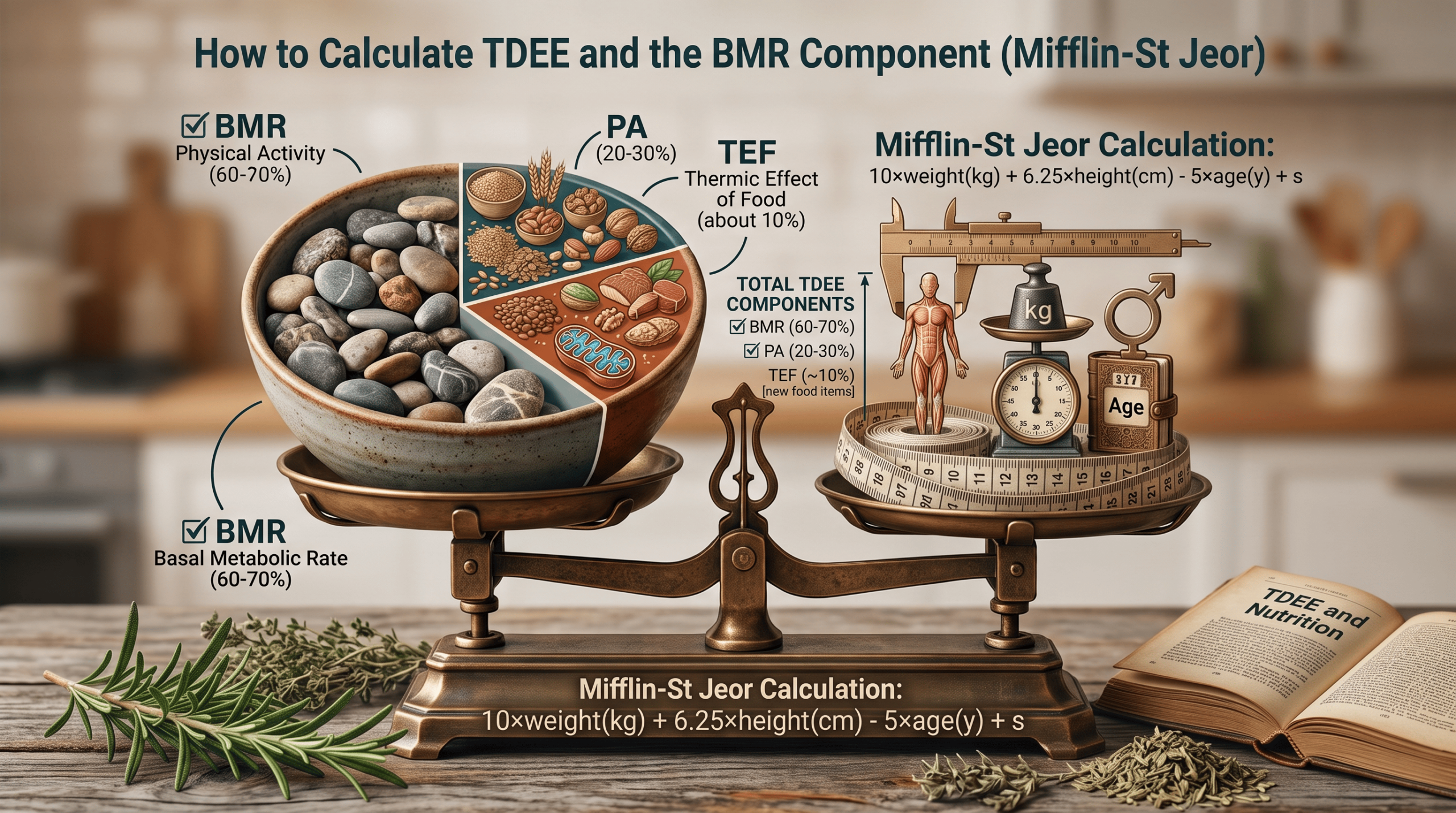
- TDEE breaks down into three components: basal metabolic rate (60-70%), physical activity (20-30%), and the thermic effect of food (about 10%).
- The Mifflin-St Jeor equation is the current clinical standard, but it is an estimate. Real-world data shows formula estimates miss by more than 250 calories a day for at least half of users.
- TDEE matters more, not less, on a GLP-1, since appetite suppression makes undereating protein and total calories a real risk, not a theoretical one.
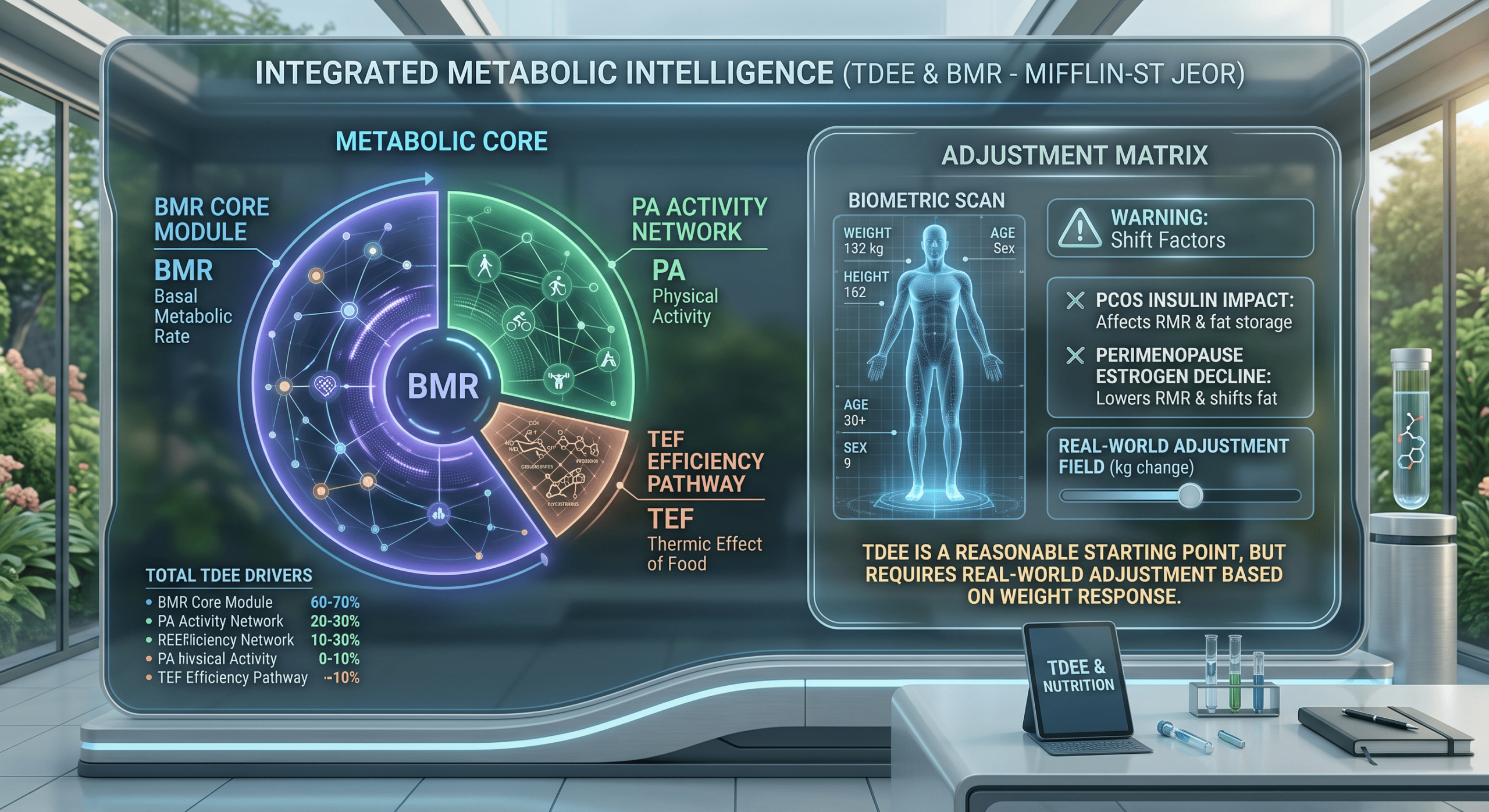
- TDEE is not fixed for everyone at the same weight. PCOS and perimenopause both shift the number in ways most TDEE content never mentions.
At a glance
| 60-70% of TDEE is your basal metabolic rate alone | 250+ cal the typical margin of error in formula-based TDEE estimates | 15-30% of TDEE from non-exercise movement (NEAT), the piece people estimate worst | 4-6 wks how often to recalculate as your weight changes |
BMR vs. TDEE: What Is the Difference?
This is the distinction every TDEE calculator is actually built on. Basal metabolic rate, or BMR, is the energy your body needs just to stay alive at rest: breathing, circulation, and basic cell function, with no activity factored in at all. TDEE takes that number and adds everything else. BMR is the starting point for the math. TDEE is the number that actually reflects your real day, and it is the one that should inform any calorie target, not BMR alone.
The three components of TDEE
Basal metabolic rate, 60-70%
The largest single component and the one every calculator targets first: what your body burns keeping your heart, brain, and organs running at complete rest.
Physical activity, 20-30%
Formal exercise plus NEAT, non-exercise activity thermogenesis: walking, standing, fidgeting, and posture changes throughout the day. NEAT alone can vary by up to 400 calories a day between two similarly sized people, which is the single biggest reason two people with an identical BMR can have meaningfully different real-world TDEE.
Thermic effect of food, about 10%
The energy your body spends digesting what you eat. Protein costs roughly 25% of its own calories to digest, compared to about 7% for carbohydrates and 2 to 3% for fat, which is one more reason protein-forward eating raises your effective energy needs rather than just protecting muscle.
How to Calculate Your TDEE With the Mifflin-St Jeor Formula
The Mifflin-St Jeor equation, developed in 1990 and validated against indirect calorimetry in a landmark study, is the formula the Academy of Nutrition and Dietetics recommends for clinical use today. It replaced the older Harris-Benedict equation because it proved more accurate for modern populations.
| Step | Formula |
| BMR, men | (10 x weight in kg) + (6.25 x height in cm) – (5 x age in years) + 5 |
| BMR, women | (10 x weight in kg) + (6.25 x height in cm) – (5 x age in years) – 161 |
| TDEE | BMR x activity multiplier |
A worked example
Here is a TDEE calculator example worked by hand. A 40-year-old woman, 70 kg (about 154 lbs), 165 cm (about 5 foot 5), with a lightly active lifestyle: BMR = (10 x 70) + (6.25 x 165) – (5 x 40) – 161 = 700 + 1,031.25 – 200 – 161 = 1,370 calories per day. Multiplying by a lightly active factor of 1.375 gives a TDEE of roughly 1,884 calories per day.
An alternative: Katch-McArdle, if you know your body fat percentage
If you have a recent body fat percentage from a DEXA scan or a reliable body composition scan, the Katch-McArdle formula uses lean body mass directly rather than estimating from total weight, and it is more accurate for people who are notably more or less muscular than average. Without that number, Mifflin-St Jeor remains the better default.
Activity Multipliers: The Second Half of Every TDEE Calculator
| Activity level | Multiplier | What it means |
| Sedentary | 1.2 | Little to no exercise, a desk job |
| Lightly active | 1.375 | Light exercise 1 to 3 days a week |
| Moderately active | 1.55 | Moderate exercise 3 to 5 days a week |
| Very active | 1.725 | Hard exercise 6 to 7 days a week |
| Extra active | 1.9 | Very hard training or a physical job on top of exercise |
Most people overestimate their own activity level by one full category. If your job involves sitting most of the day and you exercise a few times a week, lightly active is usually the honest answer, not moderately active.
Why TDEE Matters More, Not Less, on a GLP-1
Appetite suppression is the entire point of GLP-1 treatment, which means it is easy to eat well under your real energy needs without ever intending to. Undereating by a large margin does not speed up weight loss meaningfully beyond a certain point, and it does increase the risk of fatigue and muscle loss, since your body pulls harder on lean tissue for energy when intake drops too far below what it actually needs. A direct telehealth competitor already gates its own TDEE tool with a note that the number does not determine medication eligibility on its own, a reasonable caution worth repeating here: TDEE tells you what to eat, not whether GLP-1 treatment is right for you. That is a separate, individual evaluation.
For specific protein targets once you know your TDEE, see the Muscle Loss on Tirzepatide guide.
Does TDEE Change With PCOS or Perimenopause?
Yes, and this is the piece most TDEE calculator content leaves out entirely. Insulin resistance, common in PCOS, and the estrogen decline of perimenopause both independently affect resting metabolic rate and where the body stores fat, on top of whatever a standard formula estimates from weight, height, age, and sex alone. A formula-based TDEE is still a reasonable starting point in either situation, but it is more likely to need real-world adjustment based on how your weight actually responds over a few weeks, rather than being treated as exact from day one.
For the full picture on either driver, see the Complete Guide to PCOS and Menopause and the Complete Guide to GLP-1 for Hormonal Weight Gain.
Where a TDEE Calculator Gets It Wrong
- Very high body fat percentages. The Mifflin-St Jeor formula can overestimate BMR here, since it does not separate fat mass from lean mass, and fat burns fewer calories than muscle at rest.
- Very muscular individuals. The opposite problem: more lean mass than the formula assumes means the estimate can run low.
- Non-exercise movement gets underestimated constantly. NEAT can account for 15 to 30% of total TDEE and is the piece people guess worst, varying by as much as 400 calories a day between similarly sized people.
None of this means the formula is useless. It means the number it gives you is a starting estimate, not a lab measurement, and real-world data shows these estimates miss by more than 250 calories a day for at least half of the people who use them.
How Often Should You Recalculate Your TDEE Calculator Result?
Recalculate every 4 to 6 weeks, or any time your weight changes by more than about 10 to 12 pounds, since BMR drops as weight drops. A number calculated at your starting weight will overestimate your needs once you have lost a meaningful amount, which is a common reason weight loss can stall even when nothing else has changed. The CDC notes that a steady pace of about 1 to 2 pounds a week is associated with better long-term maintenance than faster loss, and Mayo Clinic guidance describes a daily deficit of roughly 500 to 750 calories below TDEE as the range that typically supports that pace.
Frequently Asked Questions
What is a normal TDEE range for adults?
A TDEE calculator typically returns a figure somewhere between 1,800 and 3,200 calories a day for most adults, depending on body size, age, and activity level. There is no single normal number.
Is the Mifflin-St Jeor formula accurate?
It is the most validated formula available for general use, but it is still an estimate. Real-world data shows a margin of error over 250 calories a day for at least half of users.
How much should I eat to lose weight based on my TDEE?
A common approach is eating 500 to 750 calories below TDEE for roughly 1 to 2 pounds of weight loss per week, the pace the CDC associates with better long-term results. The right deficit for you is worth discussing with your provider.
Does TDEE change once I start losing weight?
Yes. BMR drops as body weight drops, so recalculating every few weeks keeps the number accurate rather than working off a figure that no longer matches your body.
Why do I need to know my TDEE if I am on a GLP-1 medication?
Because appetite suppression makes it easy to eat far below your real needs without noticing, which can worsen fatigue and muscle loss rather than helping you lose weight faster.
Does PCOS change your TDEE?
It can. Insulin resistance associated with PCOS affects metabolism in ways a standard formula does not fully capture, so treat a calculated number as a starting point to adjust from rather than an exact figure.
Does perimenopause change your TDEE?
Yes, generally downward, as estrogen decline affects resting metabolic rate and shifts fat storage patterns independent of any change in diet or activity.
What activity level should I choose if I am not sure?
When in doubt, pick the lower of two options you are considering. Most people overestimate how active they actually are.
What is the difference between TDEE and the Katch-McArdle formula?
Katch-McArdle calculates BMR from lean body mass rather than total weight, which makes it more accurate if you know your body fat percentage. Without that number, Mifflin-St Jeor remains the better default.
Can I use a TDEE calculator instead of doing the math by hand?
Yes. The formula above is useful to understand what is actually happening, but AHC’s own calculators can do this math for you directly.

Skip the Manual Math
Every formula in this TDEE calculator guide is useful to understand, but you do not have to do it by hand. A TDEE calculator built into AHC’s tools handles the math directly, and a free evaluation puts your specific numbers in front of a licensed provider rather than a generic formula.
Free AHC calculators and tools
See all AHC weight loss calculators
Related reading
The Complete Guide to PCOS and Menopause
The Complete Guide to GLP-1 for Hormonal Weight Gain
Medical disclaimer
This article is for informational purposes only and is not a substitute for professional medical or nutritional advice. TDEE estimates are approximations and individual results vary. Always talk with your provider about the calorie and nutrition targets that are right for you. Semaglutide and tirzepatide are prescription medications available only after an individual evaluation by a licensed provider.