
Blog
Snoring and Sleep Position Changes During Weight Loss

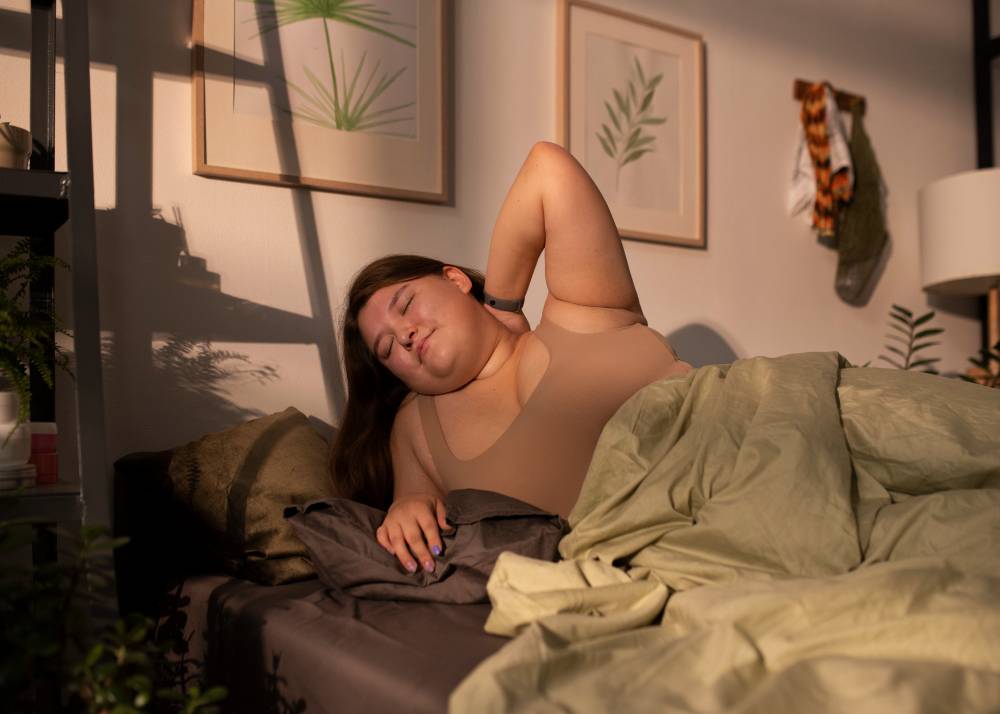
Snoring and sleep position changes during weight loss get written about as one topic with one answer: lose weight, sleep on your side, snore less. That is roughly true and it skips the part that matters most.
Snoring and obstructive sleep apnoea are not the same condition. One is a noise. The other is a diagnosis with cardiovascular consequences, and weight loss changes them by different amounts through a mechanism most pages never name.
There is also something none of the ranking pages on this topic mention. Since December 2024 a GLP-1 medication has been an FDA approved treatment for moderate to severe obstructive sleep apnoea, which changes the conversation entirely.
Snoring and sleep apnoea are not the same thing
This distinction decides whether anything on this page applies to you, and it is the one the field blurs most.
| Primary snoring | Obstructive sleep apnoea | |
| What happens | Airway partly narrows, soft tissue vibrates | Airway partly or fully closes, breathing repeatedly stops and restarts |
| How it is identified | By whoever hears it | By a sleep study, graded using the apnoea-hypopnea index |
| Main consequence | Disrupted sleep for the person next to you | Repeated oxygen drops, linked to high blood pressure, heart disease and type 2 diabetes |
| Does position help | Often | Sometimes, and it is not a substitute for diagnosis |
| Is it a medical issue | Usually not on its own | Yes, and it needs assessment |
Loud snoring is often the first sign of apnoea that anyone notices, usually reported by a partner rather than the person affected. That is why snoring that is loud, frequent or accompanied by gasping is worth raising rather than managing with a pillow.
Snoring and sleep position changes during weight loss: what the numbers show
Two studies carry most of what is known, and both are more specific than the general advice built on them.
The first is Peppard and colleagues in JAMA in 2000, a prospective study of 690 participants in the Wisconsin Sleep Cohort. It gives the figure the whole field quotes, and usually quotes only half of.
| Change in body weight | Predicted change in apnoea-hypopnea index | 95 percent confidence interval |
| 10 percent weight gain | 32 percent increase | 20 to 45 percent |
| 10 percent weight loss | 26 percent decrease | 18 to 34 percent |
Source: Peppard PE, Young T, Palta M, Dempsey J, Skatrud J. JAMA. 2000;284(23):3015-3021.
Most pages cite the 32 percent gain figure and stop, which is the direction their readers are not travelling in. The 26 percent decrease is the number that answers the actual question. One page attributes this study to the Journal of Clinical Sleep Medicine. It is JAMA.
The second is older and more specific to snoring itself. A 1995 trial studied 19 men who snored heavily, combining weight loss with side sleeping and a nasal decongestant spray.
- Among the 12 who lost any weight, snores per hour fell from 328 to 232. That did not reach significance, at p=0.15.
- Among the 9 who lost 3 kg or more, snores per hour fell from 320 to 176, which did reach significance at p=0.0496.
- Three men who lost an average of 7.6 kg had virtually no snoring afterwards.
- Those who gained weight showed no improvement at all.
- Adding weight loss had no effect on the apnoea-hypopnea index in this study, only on snoring frequency.
The authors concluded the major effect was related to the weight loss rather than to the position or the spray. Note the dose relationship, though. Losing a little did not reach significance. Losing 3 kg or more did.
The mechanism almost nobody names: tongue fat
General pages say weight loss reduces fat around the neck. That is true and incomplete, and the more precise answer is more useful.
Researchers at the University of Pennsylvania, led by Richard Schwab, used MRI to measure upper airway structures in 67 people with obesity and mild to severe obstructive sleep apnoea, before and after roughly 10 percent body weight loss over six months.
Apnoea scores improved by 31 percent. When the team analysed which anatomical change explained that improvement, the answer was a reduction in tongue fat volume. Not neck circumference. Not the soft palate. The tongue.
That matters practically for two reasons. It explains why some people improve far more than their weight change alone would predict, and it explains why neck measurements are a poor way to judge your own risk.
A GLP-1 is now an approved treatment for sleep apnoea
This is the largest development on this topic in years and it appears on none of the pages currently ranking for it.
On 20 December 2024 the FDA approved Zepbound, the branded tirzepatide injection from Eli Lilly, for adults with moderate to severe obstructive sleep apnoea and obesity. It is the first prescription medicine approved for that indication.
The approval rests on the SURMOUNT-OSA trials, which enrolled 469 participants across two studies.
| Outcome | Study 1, without PAP therapy | Study 2, with PAP therapy |
| Reduction in breathing disruptions per hour | 25 fewer, against 5 on placebo | 29 fewer, against 6 on placebo |
| Remission or mild, non-symptomatic OSA | 42 percent, against 16 percent on placebo | 50 percent, against 14 percent on placebo |
Source: Eli Lilly and Company, FDA approval announcement, 20 December 2024. SURMOUNT-OSA phase 3 programme.
Three limits belong with those numbers.
- The indication is specific. Moderate to severe obstructive sleep apnoea in adults who also have obesity. It is not an approval for snoring.
- It applies to the branded product. Compounded tirzepatide is not FDA approved, has not been reviewed by the FDA for safety, efficacy or quality, carries no approved prescribing information, and holds no sleep apnoea indication of any kind.
- It does not replace diagnosis. Sleep apnoea is identified by a sleep study, and treatment decisions including anything involving PAP therapy belong to the clinician managing it.
| Provider and compliance review required before publishing This section describes an FDA approved indication held by a branded product. It must not read as an offer, a claim about compounded preparations, or a suggestion that AHC treats obstructive sleep apnoea. Confirm the framing, the disclaimers and the escalation route against current AHC policy before publishing. |
Why your sleep position changes as you lose weight
Most articles treat position as a technique. It is often better understood as something that shifts on its own, and noticing the shift tells you something.
Sleeping on your back allows the tongue and soft palate to fall backward, narrowing the airway. People carrying more weight are more likely to end up sleeping supine, partly because side sleeping is less comfortable. As weight comes down, side sleeping often becomes easier, and some of the improvement people credit to weight loss is really that change in position.
Two things follow. If your snoring improves, you cannot tell from the outside whether that is the airway itself or the position you are now able to hold. And if you find yourself naturally sleeping differently, that is a genuine change worth mentioning at a review rather than a coincidence.
What position and the other measures actually do
Position, alcohol and nasal congestion all appear on every list. They are worth ranking honestly rather than presenting as equivalent.
| Measure | What it does | How far it goes |
| Side sleeping | Stops gravity pulling the tongue and soft palate backward | Helps many people with snoring. In the 1995 trial, position and spray together produced only minor improvement until weight loss was added |
| Raising the head of the bed | Reduces obstruction for some people | Commonly suggested at around 4 inches. Modest, and not a treatment for apnoea |
| Avoiding alcohol before bed | Alcohol relaxes throat muscles, narrowing the airway further | Real and immediate. Commonly advised 3 to 4 hours before sleep |
| Treating nasal congestion | Reduces mouth breathing, which changes airflow through the throat | Helps where congestion is the driver. On its own it did little in the trial |
| Weight loss | Reduces tongue fat and airway soft tissue | The measure with the strongest evidence, and the one the 1995 authors identified as the major effect |
The pattern is consistent. The positional measures are useful adjuncts and none of them substitutes for either weight change or, where apnoea is present, proper treatment.
Daytime habits feed into this too, particularly sleep length and alcohol timing. We cover the working-day side in desk job habits that support weight loss treatment.
Signs this is not just snoring
Snoring that comes with any of the following is worth a conversation with a clinician rather than a new pillow:
- Choking or gasping during sleep, or a partner reporting that breathing stops
- Excessive daytime sleepiness, or falling asleep when you do not intend to
- Morning headaches
- Waking unrefreshed however long you slept
- Difficulty concentrating, memory problems, or mood changes
- High blood pressure, particularly if it is difficult to control
Diagnosis is by sleep study and severity is graded using the apnoea-hypopnea index. That is not something you can assess from how loud the noise is, which is why loudness is a poor guide to whether it matters.
Why untreated apnoea makes losing weight harder
This runs in both directions, and the second direction is the one that gets missed.
Short sleep is associated with meaningful changes in the hormones that regulate appetite. In the Wisconsin Sleep Cohort, habitual sleep of around five hours rather than eight was associated with 15.5 percent lower leptin, which signals fullness, and 14.9 percent higher ghrelin, which signals hunger.
Fragmented sleep from untreated apnoea produces the same problem by a different route, alongside daytime fatigue that makes activity less likely. So apnoea plausibly makes weight harder to lose, while excess weight makes apnoea more likely, which is the loop clinicians are trying to break.
On treatment this matters less for appetite, since the medication acts on that directly, and just as much for energy and how sustainable the whole thing feels. What is ordinary fatigue during treatment and what is not is covered in how long semaglutide side effects last.
What to do if snoring changes during treatment
- Tell your provider either way. Improvement is clinically useful information and so is deterioration.
- Do not stop CPAP or any prescribed therapy on your own. Improvement in symptoms is not the same as resolved apnoea, and that call needs a clinician and usually a repeat study.
- Ask about reassessment if you have had a diagnosis. Severity can change with weight, and settings or treatment plans may need revisiting.
- Get assessed if you have never been assessed. Snoring alone is not a diagnosis, and neither is improved snoring.
- Keep the simple measures going. Side sleeping, limiting alcohol before bed and treating congestion cost nothing and work alongside everything else.
- Track the pattern rather than a single night. Alcohol, congestion and position all move night to night.
If you want to see where you sit on the measure most of this research is built around, our BMI calculator gives you the figure, and the weight loss calculator shows what a given percentage change looks like against your own numbers.
Sleep questions worth asking a clinician
How much weight do I need to lose before snoring improves?
There is no threshold that applies to everyone. In the 1995 trial, those losing any weight showed a change that did not reach significance, while those losing 3 kg or more did. The Peppard data suggests a 10 percent loss predicts a 26 percent reduction in apnoea severity, which is a population average rather than a promise.
Can weight loss cure sleep apnoea?
Cure is the wrong word. In the SURMOUNT-OSA trials, 42 to 50 percent of participants reached remission or mild, non-symptomatic OSA. That is a substantial proportion and it is not everyone, and reaching it is determined by a sleep study rather than by how you feel.
Does snoring come back if I regain weight?
The Peppard data runs in both directions, with a 10 percent weight gain predicting a 32 percent increase in apnoea severity. The 1995 trial found no improvement at all in those who gained weight. The relationship is not one-way.
Is a mouthguard or oral appliance worth trying?
Oral appliances reposition the jaw or tongue to keep the airway open and are an established option, usually fitted by a dentist working with a sleep specialist. They are a treatment decision rather than something to buy off a shelf on the basis of snoring alone.
Why do I still snore after losing weight?
Weight is one factor among several. Nasal structure, alcohol, smoking, age-related changes in throat muscle tone and sleeping position all contribute, and the tongue fat research suggests the anatomical response to weight loss varies a lot between people.
Will a sleep tracker tell me if I have apnoea?
No. Consumer devices can flag disturbed sleep or snoring patterns and that can be a useful prompt, but the apnoea-hypopnea index comes from a sleep study. Treat a device as a reason to ask rather than as an answer.
Does sleeping position matter more or less as I lose weight?
Nobody has measured that directly. What is documented is that side sleeping helps and that it often becomes more comfortable as weight comes down, which means the two changes tend to arrive together and cannot easily be separated.
Should I mention snoring on my intake form?
Yes, along with any diagnosis of sleep apnoea and any therapy you use for it. It is part of the picture a provider assesses, and it is relevant to how you are monitored.
Quieter is not the same as treated
Snoring usually improves with weight loss, and the evidence points to tongue fat rather than neck size as the reason. A 10 percent loss predicts roughly a 26 percent reduction in apnoea severity, on average, across a population.
But quieter is not the same as treated. If there was ever a suggestion of apnoea, or if your partner has ever described you stopping breathing, the change in noise is a reason to get reassessed rather than a reason to stop.
If you are considering medically supervised weight loss, you can start a free evaluation with Alternate Health Club. A licensed US provider reviews your information individually and will tell you if treatment is not appropriate for you.
Medical Disclaimer
This article is for general educational purposes and is not medical advice. It does not replace a consultation with a licensed healthcare professional. Alternate Health Club does not diagnose or treat obstructive sleep apnoea. The FDA approval described applies to a specific branded product for a specific indication. Compounded medications are not FDA approved, have not been reviewed by the FDA for safety, efficacy or quality, carry no approved prescribing information, and hold no sleep apnoea indication. Research figures cited describe published study populations rather than individual outcomes. Do not start, stop or change any medication or prescribed therapy, including PAP therapy, without speaking to a qualified provider. Individual results vary and no outcome is guaranteed.