
Blog
Skin Changes During Medical Weight Loss: What You Can and Cannot Change

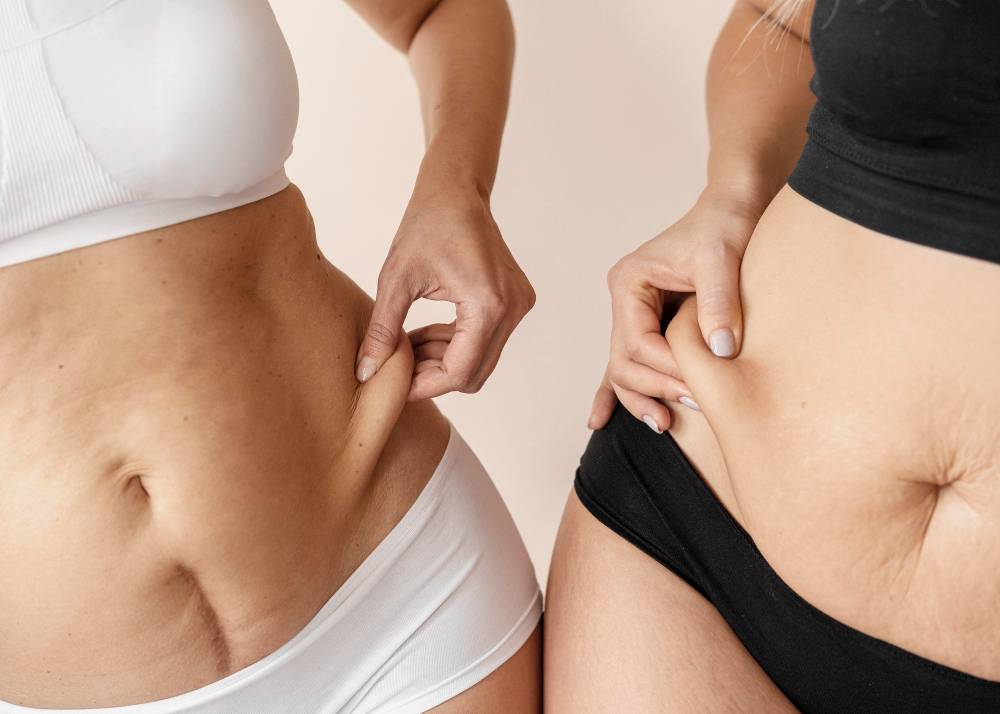
Search for skin changes during medical weight loss and almost every result is a plastic surgery page about loose skin. Those pages are detailed and they are not wrong.
They are also answering a narrower question than the one being asked. They cover what happens after the weight is gone, and say nothing about what the medication itself does to skin and hair.
Both categories are real and they need separating:
- The medication has labelled effects on skin, including injection site reactions and hair loss. The rates differ sharply between semaglutide and tirzepatide.
- The weight loss has a separate set of effects, driven by losing volume faster than skin can retract.
This page covers both. It quotes the label figures, uses the histology research that explains why skin surgery results are more limited than people expect, and is direct about which of the products sold to fix any of it have evidence behind them.
Table of Contents
Two different categories get called skin changes
Sorting your own situation into one of these two columns is the fastest way to know whether anything can be done about it.
| Effects of the medication | Effects of the weight loss | |
| What it covers | Injection site reactions, hair loss, hypersensitivity and rash | Facial volume loss, skin laxity, folds, stretch marks becoming visible |
| Evidence base | FDA clinical trial data with reported rates in the label | Histology and surgical research, mostly from bariatric populations |
| Timing | Usually early, and often around dose changes | Progressive, and continues after weight stabilises |
| Who to raise it with | Your prescribing provider | Your provider first, a plastic surgeon only if it persists after weight is stable |
| Can it be influenced | Sometimes, through the provider’s management | Partly, through pace of loss and lean mass retention |
The rest of this article works through both columns in that order, because the first one is where people are usually looking for an answer in the first weeks and the second is where they are looking six months later.
What the labels report about skin and hair
This is the data no competing page publishes, and the difference between the two molecules is larger than most people would guess.
| Reported reaction | Wegovy, semaglutide | Zepbound, tirzepatide |
| Injection site reactions | 1.4 percent against 1 percent on placebo, covering itching, redness, inflammation, induration and irritation | 6 to 8 percent depending on dose, against 2 percent on placebo |
| Hair loss | 3.3 percent at 2.4 mg against 1 percent on placebo. 5.8 percent at 7.2 mg | 4 to 5 percent depending on dose, against 1 percent on placebo |
| Hypersensitivity | Serious reactions including anaphylaxis and angioedema have been reported. Allergic reactions occurred in 16 percent of patients who developed anti-semaglutide antibodies and 7 percent of those who did not | 5 percent against 3 percent on placebo, and the label states the majority were skin reactions such as rash and itching |
| Rash and urticaria | In the pediatric trial, rash in 3 percent and urticaria in 3 percent, against no placebo patients | Not separately quantified |
Sources: FDA prescribing information, Section 6.1. Wegovy revised 18 June 2026, Zepbound revised 8/2026. Rates come from separate trial programmes and are not a head to head comparison.
Two things in that table deserve pulling out.
Injection site reactions were reported around four to six times more often with tirzepatide than with semaglutide. The figures come from separate trial programmes rather than a head to head study, so treat the size of the gap as indicative. It is still worth knowing before you assume a local reaction means something has gone wrong.
The hair loss figures also split by sex in a way the headline rate hides completely.
| Wegovy dose | Women | Men | Placebo |
| 2.4 mg, pooled studies | 4 percent | 0.9 percent | 1 percent |
| 7.2 mg trials | 8.4 percent | 0.2 percent | 1 percent |
At the lower dose the reported rate in women is more than four times the rate in men. The single blended figure of 3.3 percent tells you nothing about which side of that you sit on.
What the labels do not do is explain why. They report hair loss as an adverse reaction and stop there. Any page telling you the mechanism is going beyond what has been published.
| Provider and compliance review required before publishing This section covers injection site reactions and labelled adverse reactions. It deliberately contains no injection technique, site or rotation guidance. Confirm the framing and the escalation route against current AHC policy before publishing. |
One limit applies to every figure above. These rates come from the FDA approved branded products. Compounded semaglutide and compounded tirzepatide are not FDA approved, have no approved prescribing information, and have no adverse reaction rates of their own.
Contact a provider, or urgent care, rather than working around any of the following:
- A skin reaction that is spreading, painful, blistering or broken
- A reaction that has not settled after a few days
- Swelling of the face, lips or tongue, or any difficulty breathing
- Hair loss that is rapid, patchy, or accompanied by other symptoms
What is ordinary and what is not is covered in how long semaglutide side effects last.
Ozempic face is rapid weight loss, not a drug effect
The term is everywhere and it is misleading. A 2024 paper in the Journal of Drugs in Dermatology examined the phenomenon directly and concluded that “evidence of GLP-1 agonists favoring adipose catabolism of the face, as opposed to other body regions, is lacking.”
In other words, there is no published evidence that these medications target facial fat. What is happening is that people are losing a significant amount of weight relatively quickly, and the face is where volume loss is most visible. The same appearance occurs after bariatric surgery and after rapid weight loss without any medication at all.
That reframing matters, because it changes what you can do about it. If the drug were selectively removing facial fat, the answer would be the drug. It is not.
Facial volume loss and skin laxity are not the same thing
Almost every article treats these as one problem. They are two, and separating them changes what is worth trying.
| Facial volume loss | Skin laxity | |
| What it is | Fat pads in the face get smaller, so the underlying structure shows more | Skin has stretched over time and does not fully retract to the smaller shape |
| Why it happens | Fat is lost from the whole body, and the face has less of it to lose in the first place | Collagen and elastic fibre in the dermis have been altered by prolonged stretching |
| Does it reverse | Volume returns if weight returns, which is not the goal | Skin retraction is slow and partial, and depends on the factors below |
| What influences it | How much weight is lost, and how fast | Age, how long the weight was carried, how much was lost, sun damage, smoking, genetics |
Somebody in their thirties who carried extra weight for two years and lost it over a year is in a different position from someone in their sixties who carried it for thirty years and lost it in six months. Both will be told the same thing by a page selling a procedure.
What research shows about skin changes during medical weight loss
Two histology studies carry most of what is actually known. The more useful of the two is almost never cited outside the surgical literature.
| Study | What it compared | What it found |
| Rocha, Obesity Surgery, 2021 | 20 patients after massive weight loss against 20 patients who still had obesity | Total collagen unchanged. Thick collagen fibres reduced, thin fibres increased, elastic fibre density increased |
| Hany, Obesity Surgery, 2024 | Skin after surgical weight loss against skin after non surgical weight loss | Collagen 49.2 percent against 49.5 percent, no significant difference. Elastic fibre 5 percent against 6.8 percent, significantly lower after surgery |
The Rocha finding is the one that explains things. The dermis does not lose collagen so much as reorganise it. The authors describe “consequent reduction of thick, organized, structured, and directed fibers in favor of thin, misaligned, and loosely arranged fibers.”
The two studies are sometimes presented as contradicting each other on elastic fibre. They are not. Rocha compared people after weight loss against people who still had obesity. Hany compared two groups who had both lost weight, by different methods and at different speeds.
Read together, they give two things worth carrying:
- The method matters less than most people assume. Collagen ended up in the same place either way.
- The pace matters more. The faster group had less elastic fibre remaining.
Why skin surgery results are more limited than people expect
The Rocha paper is titled for this conclusion, and it is the part that never reaches consumer pages. The study set out to explain why body contouring outcomes are limited in people who previously had obesity. It found the answer in the dermis rather than in the surgery.
Skin that has been stretched and then emptied is not simply larger skin. Its structural fibres have been remodelled into a thinner, more disorganised arrangement. A surgeon can remove the excess. Nobody can restore the architecture underneath.
This is not an argument against surgery. It is a reason to walk into a consultation expecting improved contour and function rather than the skin quality you had before, and to be sceptical of any before and after gallery implying otherwise.
How to tell loose skin from remaining fat
People often assume the fullness left after weight loss is all loose skin, and that assumption changes what they think their options are. Three things can produce it, sometimes together.
| What it is | How it tends to feel | What it means |
| Loose skin | Folds or creases, thinner, an empty feel when you lift it | Will not respond to further weight loss or to exercise once true excess is present |
| Remaining fat | Thicker and fuller, feels similar whatever position you are in | Can still respond to continued fat loss |
| Muscle and abdominal wall | Firmer, and changes with posture rather than position | Responds to resistance training, though stretched abdominal wall does not tighten with exercise alone |
That is a rough guide and not a diagnosis. It is useful because the three have different answers, and because a page selling a procedure has no reason to tell you that what you are feeling might still be fat.
Where loose skin actually shows up
Loose skin rarely stays in one place, which surprises people expecting it only on the abdomen. After significant loss it tends to follow a belt-like distribution, because the supporting tissue of the lower torso stretches as a unit.
Common patterns:
- A belt across the lower abdomen, the flanks and the lower back
- A hanging fold on the lower abdomen, called a pannus or a skin apron
- Descent of the outer thighs and buttock tissue
The distribution, rather than the total amount, is what determines which procedures are even relevant if it ever gets that far. It is also why looking at yourself standing and moving tells you more than looking while lying flat.
Skin folds, rashes and the part that is a medical problem
There is a line between a cosmetic concern and a medical one, and skin folds are where it sits. Folds trap moisture and sweat, which produces:
- Chafing and irritation
- Recurrent rashes, sometimes called intertrigo
- Difficulty keeping the area clean and dry
- Skin infections in deeper folds
These are functional symptoms rather than appearance concerns, and they are assessed differently. A 2019 review in the Journal of the American Academy of Dermatology makes the same point about redundant skin after major weight loss, treating recurrent rashes, infections and frictional discomfort as recognised complications rather than side notes.
A rash in a fold that keeps returning despite keeping the area clean and dry is worth a clinician looking at. So is any area that is broken, weeping or spreading.
The products sold to fix this, and what the evidence says
This is the section the ranking pages cannot write, because most of them are selling one of these.
| What is sold | What the evidence shows | Honest reading |
| Collagen supplements | A 2025 meta analysis of 23 randomised trials covering 1,474 participants concluded there is currently no clinical evidence to support collagen supplements to prevent or treat skin aging. High quality studies within it found no significant effect | No evidence in skin aging generally, and none at all in people after major weight loss |
| High intensity focused ultrasound devices | The largest systematic review, covering 45 studies to October 2024, reports improvements in skin laxity of 18 to 30 percent in the lower face, neck and around the eyes | That review does not address people after major weight loss at all. The population studied is not the population being sold to |
| Topical treatments for Ozempic face | The one study specifically on this had 29 participants over 12 weeks and reported a 20.7 percent reduction in wrinkle severity | Open label, no control arm, 29 people, 12 weeks. The authors say so themselves. Not a basis for a purchase decision |
| Exercise for loose skin | Resistance training builds what sits under the skin. No evidence shows it removes established skin excess | Worth doing for lean mass. It will not remove a fold that already exists |
| Surgical body contouring | Established for removing excess skin. The American Society of Plastic Surgeons states candidates are adults whose weight loss has stabilised | Real, and appropriate for some people. It is a surgical decision, not a first response |
The pattern is consistent. Where evidence exists, it is either in a different population or from studies too small to act on. Where the intervention is genuinely established, it is surgery.
The two things you can actually influence
The rate of loss
This is the one with a mechanism behind it. Slower loss gives skin more time to retract, and the elastic fibre finding above supports the direction.
This is not something to manage by skipping doses. Titration is a provider decision and self adjusting a dose is never advised. It is a reason to be less disappointed by a steady pace, and to raise the question with your provider rather than to push for faster.
If you want to see what a given rate looks like against your own numbers, our weight loss calculator and the GLP-1 weight loss projection calculator will show you the arithmetic. Neither predicts what will happen to you.
How much lean mass you keep
Weight on a scale is not the same as fat. What you keep underneath affects how the result looks, and the evidence here is genuinely mixed, so both sides belong on the page.
Two recent analyses disagree, so both belong here:
- A 2025 analysis of nine randomised trials, 659 participants, found 5.4 kg of fat loss alongside 2.5 kg of lean mass loss. That puts lean mass at roughly 31 percent of the total.
- A larger 2026 review of 36 studies concluded the opposite emphasis, reporting relative preservation of lean tissue with loss coming primarily from fat.
Both are recent and peer reviewed. The honest position is that lean mass loss happens and its magnitude is contested.
On what helps, one point is routinely overstated. A trial in postmenopausal women found that a high protein diet at 1.5 g per kg per day, without exercise, did not preserve fat free mass. A separate trial found that only the group combining higher protein with resistance exercise significantly increased it.
Protein alone was not enough. Protein plus resistance training was the variable that moved.
Our GLP-1 protein calculator gives you a daily protein target from your weight, and the body fat percentage calculator helps you track composition rather than only the scale number. We cover the muscle side in more detail in preventing muscle loss on tirzepatide.
If surgery becomes the question, the pattern decides which one
Most people never get here, and the ones who do are usually driven by symptoms rather than appearance. If it does come up, the vocabulary is worth knowing before the consultation, because the procedures are not interchangeable.
| Procedure | What it does | When it tends to be discussed |
| Panniculectomy | Removes the overhanging fold of skin and soft tissue from the lower abdomen. It does not reshape the abdominal wall | A large hanging apron causing rashes, hygiene difficulty or interference with movement |
| Abdominoplasty, or tummy tuck | Removes lower abdominal skin and can address the abdominal wall | Loose skin mainly at the front of the abdomen |
| Lower body lift, or belt lipectomy | Removes excess skin around the whole lower torso | A belt-like pattern involving the abdomen, flanks and lower back |
Timing is governed by weight stability. The American Society of Plastic Surgeons states that candidates are adults whose weight loss has stabilised, and it publishes no number of months, so any specific figure you read is somebody’s interpretation. Continued loss after an operation changes the result, and regain stretches the tissue again.
One finding is worth carrying into that consultation. A 2026 analysis published through the American Society of Plastic Surgeons followed 373 abdominal panniculectomy patients over ten years, 21.7 percent of them GLP-1 users:
- Delayed wound healing was more common in GLP-1 users, 18.5 percent against 7.5 percent
- Seroma was less common, 4.9 percent against 14.0 percent
- The authors concluded these medications appear broadly safe perioperatively
The instruction that follows is one sentence. Tell the surgical team exactly what you take and at what dose, and let them plan around it.
Questions we are asked most about skin changes
Will hair loss on a GLP-1 grow back?
The labels do not say. They report hair loss as an adverse reaction and give the rates, and neither the Wegovy nor the Zepbound label addresses whether it reverses. Anyone giving you a recovery timeline is going past the published evidence. Raise it with your provider rather than treating it yourself.
Is an injection site reaction the same as an allergic reaction?
The labels treat them as separate things. Injection site reactions are local, covering itching, redness, inflammation, induration and irritation. Hypersensitivity is systemic and is listed separately, including serious reactions such as anaphylaxis and angioedema. Swelling of the face or lips, or any difficulty breathing, is the second category and needs urgent care.
Do compounded semaglutide and tirzepatide have the same skin effects?
Nobody can say. Every rate on this page comes from an FDA approved branded product. Compounded preparations are not FDA approved, have no approved prescribing information, and have no adverse reaction rates of their own. The molecule is the same, the published data does not transfer automatically, and that is a conversation for your provider.
Should I stop treatment because I am worried about loose skin?
Stopping is a provider decision, not a self-managed one. It is also worth knowing that stopping does not reverse laxity that has already developed, because the change is in the structure of the dermis rather than in the medication. If pace is your concern, that is the conversation to have.
Would switching medications reduce injection site reactions?
The labelled rates do differ, with semaglutide reporting fewer than tirzepatide. No study has compared them head to head for this, the figures come from separate trial programmes, and switching is a clinical decision that weighs far more than one adverse reaction. Bring the reaction to your provider and let them weigh it.
Can I use a skin tightening device while I am still losing weight?
Two problems with that. The evidence for these devices comes from people who have not had major weight loss, so it does not describe your situation. And skin continues to change while weight is still moving, so anything done now is being done to a moving target.
Can I see a plastic surgeon before my weight is stable?
You can consult at any point, and an early consultation can be useful for understanding the options. What happens after weight stabilises is the planning, because the amount and distribution of excess skin cannot be assessed accurately while weight is still changing.
What should I actually tell my provider about a skin change?
Four things make the conversation useful:
- What you are seeing, and where on your body
- When it started, and whether that was near a dose change
- Whether it is getting better, staying the same, or spreading
- Anything else that changed at the same time, including other medications
What is reasonable to expect
Skin retraction is slow, partial and highly individual. It continues long after weight stabilises, which is one reason the surgical guidance is to wait for stability before deciding anything.
Nobody can tell you in advance how much your skin will retract, because the determinants include how long you carried the weight and your genetics, neither of which anyone can assess from a photograph. Any page giving you a percentage or a timeline is guessing.
Two things are worth doing in the meantime and neither costs anything. Track composition rather than only the scale, so you can see what you are keeping. And treat pace as information rather than as a race, because it is one of the few variables with a mechanism behind it.
If you want to understand what medically supervised treatment involves, you can start a free evaluation with Alternate Health Club. A licensed US provider reviews your information individually and will tell you if treatment is not appropriate for you.
Medical Disclaimer
This article is for general educational purposes and is not medical advice. It does not replace a consultation with a licensed healthcare professional. Adverse reaction rates cited come from the FDA approved labels for the branded products named, and describe those trial populations. Compounded medications are not FDA approved, have not been reviewed by the FDA for safety, efficacy or quality, and have no approved prescribing information of their own. Research figures cited describe published study populations, not individual outcomes. Do not start, stop or change any medication or dose without speaking to a qualified provider. Individual results vary and no outcome is guaranteed.